
Smooth, secure network management often slips out of reach when juggling rapid growth and complex systems across multiple Stockholm offices. Reliable centralised control is more than convenience for small and medium-sized businesses, it underpins productivity, protects data, and empowers teams to operate without disruption. With the hybrid cloud architecture of UniFi, your organisation gains robust, centralised visibility and powerful tools for unified oversight, custom user authentication, and adaptable performance for any deployment scale.
Table of Contents
- UniFi Controller: Centralised Network Management
- Types of UniFi Controller Deployments
- Core Features For Home And Business
- Network Cabling Integration And Best Practices
- Risks, Costs And Common Challenges
- Comparing UniFi Controller To Alternatives
Key Takeaways
| Point | Details |
|---|---|
| Centralised Management Advantages | The UniFi Controller provides unified network monitoring, real-time management, and robust security features, enhancing operational efficiency. |
| Flexible Deployment Options | Various deployment models, including cloud-hosted and local options, enable organisations to tailor their infrastructure to specific needs. |
| Comprehensive Feature Set | Features like network topology mapping and automated updates ensure effective management for both home and enterprise environments. |
| Consider Financial Implications | Understanding total costs, including ongoing maintenance and potential risks, is essential for sustainable network performance. |
UniFi Controller: Centralised Network Management
The UniFi Controller represents a sophisticated network management platform that empowers organisations to streamline their network infrastructure with unprecedented control and visibility. Hybrid cloud architecture enables seamless, secure network administration across diverse technological environments.
Centralised management through UniFi Controller delivers several critical advantages for modern network environments:
- Unified dashboard for comprehensive network monitoring
- Real-time device configuration and management
- Scalable architecture supporting single and multi-site deployments
- Robust security controls and user authentication mechanisms
- Automated firmware updates and network optimisation
The platform’s core strength lies in its ability to integrate active directory services seamlessly. This integration allows organisations to leverage existing user management infrastructures while maintaining granular access controls and security protocols.
Networks managed through UniFi Controller benefit from advanced features like device profiling, network segmentation, and intelligent traffic management. Administrators can configure complex network topologies with minimal complexity, reducing operational overhead and improving overall network performance.
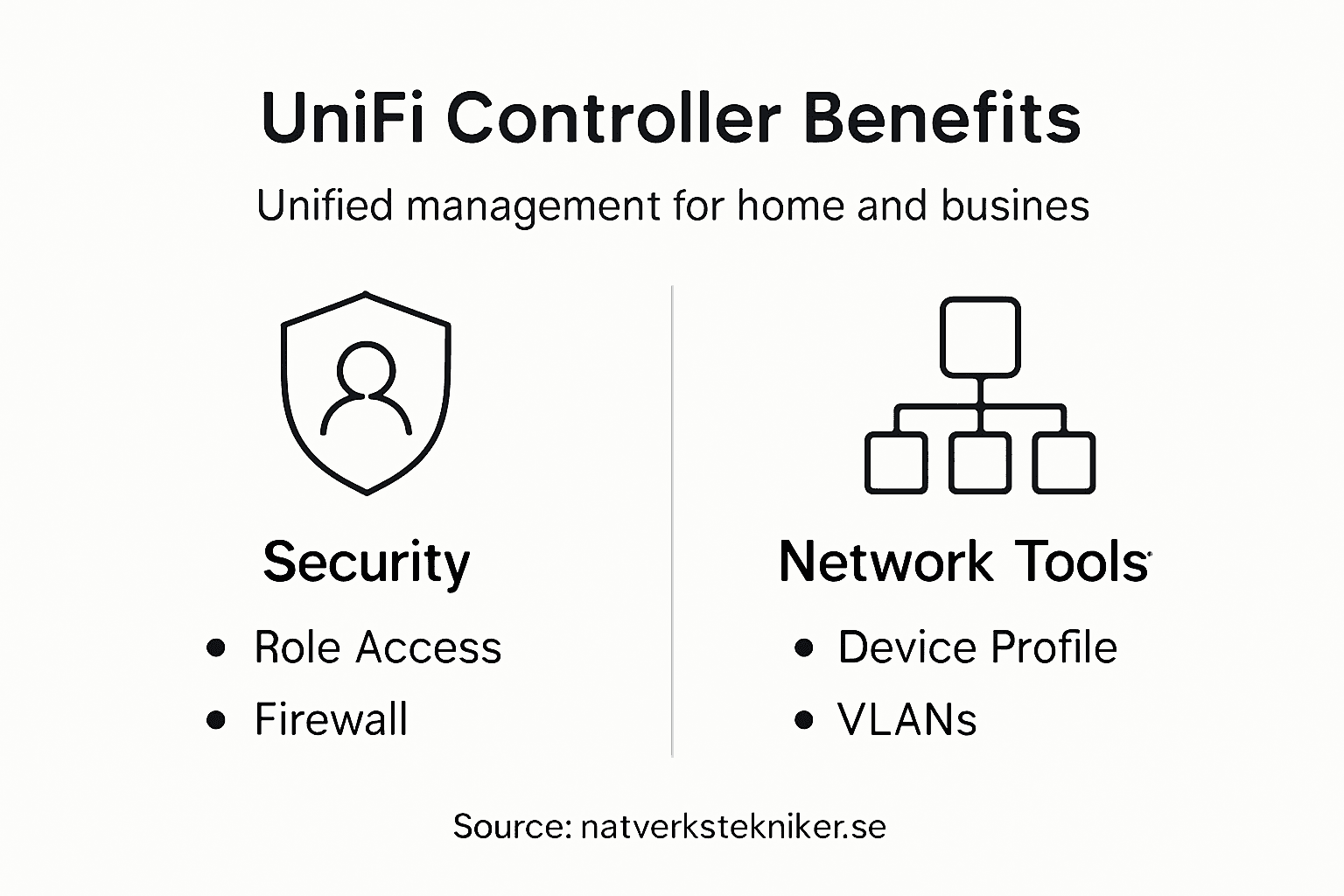
Pro tip: Configure role-based access controls within your UniFi Controller to enhance network security and streamline user management processes.
Types of UniFi Controller Deployments
The UniFi Controller offers multiple deployment options designed to accommodate diverse network infrastructures and organisational requirements. These flexible deployment strategies enable businesses to select the most appropriate architecture that aligns with their specific technological ecosystem and operational constraints.
Key deployment models for UniFi Controller include:
- Local Controller: Installed directly on a dedicated server or computer within the organisation’s network
- Cloud-Hosted Controller: Deployed on cloud platforms like AWS, Azure, or Google Cloud
- UniFi Dream Machine (UDM): Integrated hardware solution with built-in controller functionality
- Virtual Machine (VM) Controller: Deployed on virtualised infrastructure
- Networked Controller: Accessible across multiple physical locations
Each deployment model presents unique advantages tailored to different network scales and complexity levels. Local controllers provide maximum control and immediate network management, while cloud-hosted solutions offer enhanced scalability and remote accessibility.
The selection of a deployment strategy depends on critical factors such as network size, security requirements, budget constraints, and existing infrastructure. Organisations must carefully evaluate their specific needs to determine the most suitable UniFi Controller implementation that balances performance, flexibility, and operational efficiency.
Here’s a comparison of UniFi Controller deployment models and their practical organisational use cases:
| Deployment Model | Best Use Case | Primary Benefit |
|---|---|---|
| Local Controller | Small offices, single sites | Direct control, low latency |
| Cloud-Hosted Controller | Multi-site, remote teams | Centralised access, easy scaling |
| UniFi Dream Machine | Homes, small businesses | Simple setup, minimal hardware |
| Virtual Machine Controller | Organisations with virtualised IT | Resource efficiency, flexible setup |
| Networked Controller | Distributed branches | Cross-location management |
Pro tip: Conduct a comprehensive network assessment before selecting your UniFi Controller deployment model to ensure optimal alignment with your organisational infrastructure.
Core Features for Home and Business
The UniFi ecosystem delivers a comprehensive suite of features designed to meet the diverse networking requirements of both home users and enterprise environments. Comprehensive IT solutions enable organisations to manage multiple technological domains through a unified platform.
Key features across home and business networks include:
- Advanced network topology mapping
- Real-time traffic monitoring dashboards
- Integrated firewall and security controls
- Scalable device provisioning
- Multi-site management capabilities
- VPN support and network segmentation
- Automated firmware updates
- Comprehensive device management
Network Security represents a critical component of the UniFi architecture. Enhanced cybersecurity tools like Zone-Based Firewall and CyberSecure by ProofPoint provide robust protection against emerging digital threats, ensuring network integrity across various deployment scenarios.

The platform’s flexibility allows seamless adaptation between residential and commercial environments. Small home networks and large enterprise infrastructures can leverage identical management principles, creating a consistent and intuitive networking experience that scales effortlessly with organisational growth.
Pro tip: Regularly update your UniFi Network Application to access the latest security features and performance improvements.
Network Cabling Integration and Best Practices
Network cabling forms the critical backbone of any robust UniFi deployment, determining the overall performance and reliability of your network infrastructure. Effective cable management underpins network scalability, ensuring optimal signal performance and long-term operational efficiency.
Key considerations for network cabling integration include:
- Selecting appropriate cable categories (Cat6/Cat6a/Cat7)
- Implementing structured cabling designs
- Maintaining proper cable bend radius
- Ensuring consistent cable labelling
- Managing cable pathways and bundle organisation
- Protecting cables from electromagnetic interference
- Planning for future network expansion
- Implementing systematic documentation practices
Traffic segregation represents a crucial aspect of network design. Integrating VLANs with UniFi Security Gateway enables precise network segmentation, preventing potential performance bottlenecks and enhancing overall network security.
Professional cable management involves more than physical organisation. It encompasses strategic planning, disciplined implementation, and ongoing maintenance to support network reliability, reduce potential failure points, and create a scalable infrastructure that adapts to evolving technological requirements.
Pro tip: Invest in high-quality cable management tools and develop a comprehensive documentation system to streamline future network modifications and troubleshooting.
Risks, Costs and Common Challenges
Network infrastructure investments demand comprehensive understanding of potential pitfalls and financial implications. Vendor lock-in and cloud dependencies represent significant considerations that organisations must carefully evaluate before committing to UniFi ecosystem solutions.
Key risks and challenges include:
- Potential for proprietary technology constraints
- Ongoing hardware replacement expenses
- Complex administrative configuration requirements
- Limited interoperability with non-UniFi devices
- Continuous controller software operational costs
- Privacy concerns with cloud-integrated systems
- Network throughput limitations
- Firmware update management complexity
Technical complexity remains a significant barrier for many organisations. Network application challenges frequently emerge from intricate setup processes that require specialised technical expertise, particularly when integrating multiple network components and managing advanced configurations.
Financial considerations extend beyond initial hardware purchases. Organisations must factor in long-term operational expenses, potential upgrade requirements, and the recurring costs associated with maintaining a sophisticated network infrastructure. Careful strategic planning becomes essential to mitigate unexpected financial burdens and ensure sustainable network performance.
Pro tip: Conduct a comprehensive total cost of ownership analysis before implementing UniFi solutions to understand both immediate and long-term financial implications.
Comparing UniFi Controller to Alternatives
The network management landscape offers diverse solutions, with UniFi Controller representing one of several competing platforms. Open-source alternatives like OPNSense challenge UniFi’s market position by providing more granular control and advanced configuration options.
Key comparative aspects include:
- Ecosystem integration capabilities
- User interface complexity
- Advanced network feature availability
- Pricing and licensing models
- Hardware compatibility
- Customisation potential
- Security configuration depth
- Cloud dependency requirements
Network management philosophies differ significantly between platforms. Comparative platform discussions reveal nuanced trade-offs between user-friendly interfaces and advanced technical capabilities. UniFi excels in seamless hardware integration, while alternatives like OPNSense offer more sophisticated network manipulation tools.
The selection between UniFi and alternative platforms ultimately depends on specific organisational requirements. Technical complexity, budget constraints, existing infrastructure, and desired level of administrative control will determine the most appropriate network management solution. Professionals must conduct thorough evaluations, considering long-term scalability and potential future technological requirements.
Below is a summary of alternative platform strengths versus UniFi Controller focus areas:
| Aspect | UniFi Controller | Open-Source Alternatives |
|---|---|---|
| User Interface | Intuitive, visual dashboard | Highly customisable, less visual |
| Security Approach | Device-led, integrated tools | Community-driven, manual setup |
| Hardware Integration | Seamless with UniFi devices | Variable, depends on drivers |
| Cost Structure | Proprietary, predictable fees | Mostly free, support may cost |
Pro tip: Perform a comprehensive feature comparison and pilot testing before committing to any network management platform to ensure alignment with your specific operational needs.
Unlock the Full Potential of Your UniFi Network Today
Managing your network effectively with UniFi Controller means overcoming setup complexity and ensuring your system is scalable, secure and future-proof. Whether you are a private user or a business, common challenges such as optimising network cabling, configuring VLANs for security or integrating multiple devices can slow you down and cause frustration.

At natverkstekniker.se, we specialise in professional network installations with Ubiquiti UniFi to deliver reliable, high-performance networks tailored to your exact needs. Our expert team handles everything from strategic planning and seamless UniFi Controller deployment to meticulous network cabling with Cat6/Cat6a/Cat7 and structured cable management ensuring long-term stability.
Do not wait until network problems disrupt your workflow or home connectivity. Secure performance, simplified central management and scalable infrastructure are just a call away. Contact us now at tel:0840011726 08 400 117 26 or email kontakt@natverkstekniker.se. Ready to boost your network efficiency? Click the button below and Boka Tid with our specialists to get started immediately!
Unlock your network’s potential with proven UniFi expertise at natverkstekniker.se. Learn more about our comprehensive UniFi installation services and take control of your network today.
Frequently Asked Questions
What are the key benefits of using UniFi Controller for network management?
The UniFi Controller provides a unified dashboard for comprehensive network monitoring, real-time device configuration, scalable architecture for multiple sites, and robust security controls, making it ideal for streamlined network management.
How does UniFi Controller enhance network security?
It integrates advanced security features, including role-based access controls, integrated firewalls, and cybersecurity tools, ensuring robust protection against digital threats while maintaining user management and granular access controls.
What deployment options are available with UniFi Controller?
UniFi Controller offers various deployment models, including Local Controller, Cloud-Hosted Controller, UniFi Dream Machine, Virtual Machine Controller, and Networked Controller, each designed for different network scales and operational requirements.
How can I optimise my UniFi network performance?
To optimise performance, regularly update the UniFi Network Application, implement proper cable management practices, and configure VLANs for traffic segregation, ensuring your network is efficient and responsive.